Introducing Warden Code: Bootstrap Warden Agents in Minutes
The agentic internet needs more than ideas.
It needs builders.
Today, we’re not just launching an agent scaffolder.
We’re launching Warden Code — our “Claude Code” for the Warden ecosystem.
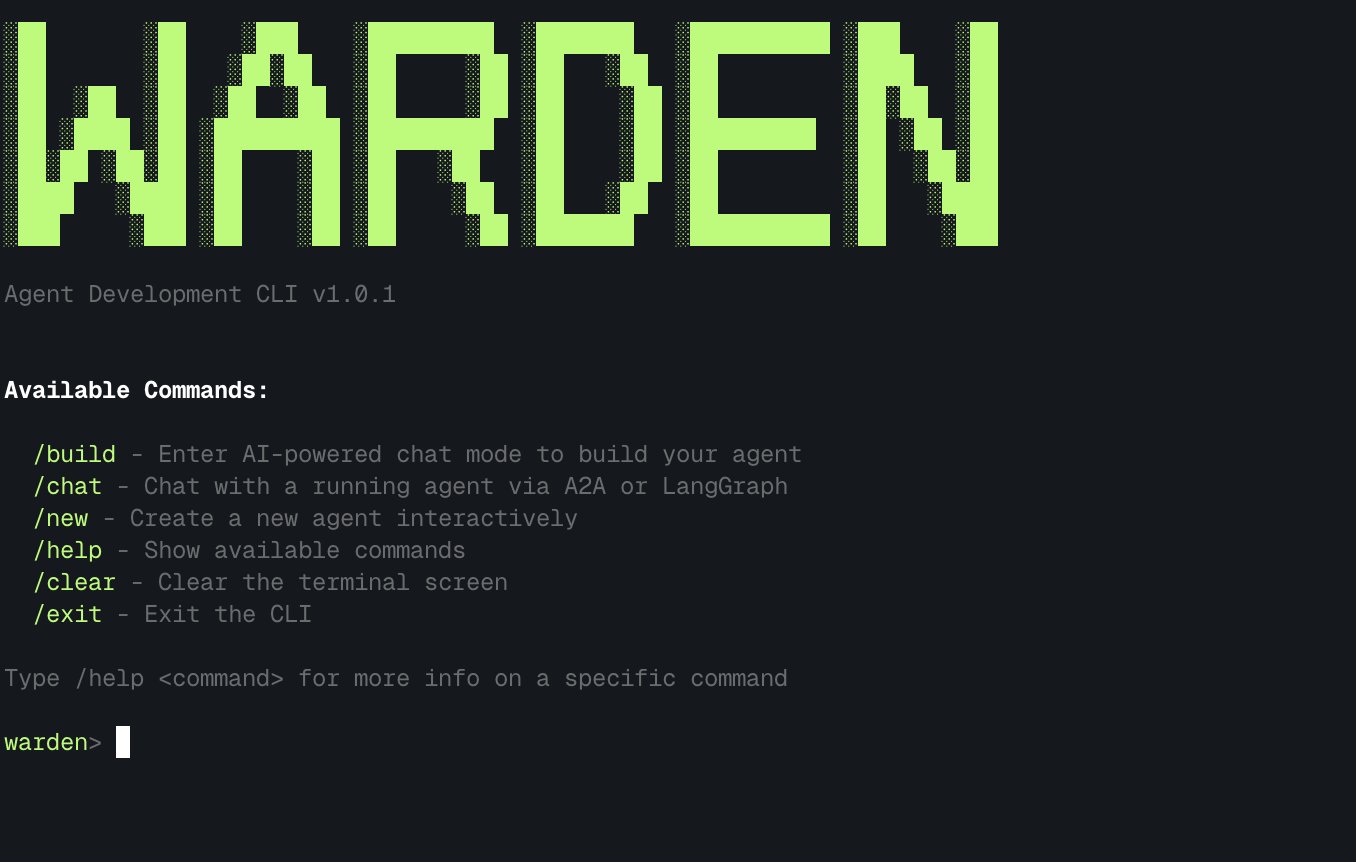 An interactive CLI that now lets you:
Bootstrap production-ready Warden agents in minutes
Use built-in A2A + LangGraph support
Vibe code your agent with AI directly inside the tool
If you’ve been waiting for the fastest way to start building agents on Warden — this is it.
From Zero to Agent, Fast
Warden Code is a simple CLI that scaffolds a production-ready agent project with best practices already wired in.
Install it globally:
npm install -g warden-code
Then run:
warden
Or skip installation:
npx warden-code
You’ll launch into an interactive wizard that walks you through creating a new agent step by step.
No boilerplate hunting.
No guessing project structure.
No protocol confusion.
Just answer a few prompts — and your agent is ready.
Now with AI-Driven Development (Vibe Coding)
This is the major upgrade.
Warden Code now supports AI-driven development directly inside the CLI.
All you need is your API key (OpenAI or Claude), and you can start building your agent conversationally.
Two powerful new commands:
/build — Enter Build Mode
This puts you into AI-powered development mode.
Describe what you want your agent to do.
Iterate. Refine. Expand capabilities.
The CLI will generate and modify your agent’s code for you.
It’s vibe coding — but for production-ready Warden agents.
/chat — Talk to Your Agent
Want to test your agent instantly?
Use /chat to interact with it directly from the CLI.
Perfect for:
Quick testing
Iterating on behavior
Validating multi-turn logic
Debugging flows
You build and test without ever leaving the terminal.
Built for the Agentic Stack
Every agent generated with Warden Code uses the AgentServer from @wardenprotocol/agent-kit, exposing:
A2A Protocol (Agent-to-Agent communication)
LangGraph Protocol (graph-based orchestration support)
This means your agent isn’t just a script.
It’s immediately compatible with the broader Warden ecosystem and the emerging agent network.
Whether you’re experimenting or shipping production logic, you’re aligned with the stack from day one.
What You Can Generate
When you run /new, the CLI guides you through:
Agent name
Description
Model type
Capability mode
Optional skills
You can choose between:
Lightweight demo agents
GPT-powered agents with streaming and multi-turn support
Fully AI-assisted agents built interactively via
/build
The generated project includes everything you need:
my-agent/
├── src/
│   ├── agent.ts
│   └── server.ts
├── package.json
├── tsconfig.json
├── Dockerfile
├── .env.example
└── .gitignore
Your core logic lives in src/agent.ts.
The server setup is handled.
Docker support is included out of the box.
Run Locally in Seconds
Once generated:
cd my-agent
npm run build
npm run agent
Your agent will be live at:
http://localhost:3000
From there, you can test, extend, connect to other agents, or deploy to your preferred cloud provider:
AWS
Google Cloud
Azure
Render
Docker anywhere
You control the infrastructure.
This Is Our “Claude Code” Moment
Above everything, Warden Code is about lowering friction.
It turns agent development from:
Set up tooling, wire protocols, configure servers, connect models…
into:
Describe the agent you want. Build it. Test it. Ship it.
We don’t just want internal agents.
We want a network of interoperable agents built by the community.
Warden Code standardizes structure.
Aligns developers around shared protocols.
And now — with AI build mode — makes experimentation radically easier.
If we want a real agent economy, we need tools that make building agents trivial.
This is that tool.
Open Source, Built in the Open
Warden Code is open source under the Apache-2.0 license.
Inspect it.
Fork it.
Extend it.
Improve it.
We want this CLI to evolve with the ecosystem — and that only happens with community feedback.
Start Building
If you’ve been thinking about building a Warden-compatible agent, now’s the time.
Clone the repo.
Run the CLI.
Enter /build.
Vibe code your agent.
Ship something.
👉 Start building today:
https://github.com/warden-protocol/warden-code
👉 Join the discussion and help improve the project:
https://github.com/warden-protocol/warden-code/discussions
The agentic internet won’t build itself.
Let’s write it.