The Warden Story - Part II: What We’ve Built

Vision is great. At the end of the day, it is worth pretty much nothing. Execution is everything.
After establishing the why behind Warden Protocol, the real challenge began. Building infrastructure that could actually support agents acting on behalf of users, while executing continuously on real user feedback.
This was never about shipping a product and calling it done. It was about iterating, testing, breaking things, and rebuilding them better. Crypto UX has been broken for years: too many dashboards, too many tabs, too much cognitive load. Warden leaned into a different idea: what if users stopped managing steps and instead focused only on outcomes?
The AI Trading Terminal and the Warden App reframed how users interact with crypto:
Intent → Command → Execution → Onchain Proof
Instead of learning to navigate protocols, users describe outcomes, agents coordinate the work: UX stopped being a bottleneck. It became a multiplier.
The Numbers: Proof of Execution
By early 2026, the numbers told a story execution made impossible to ignore:
11,050,500+ cumulative onchain transactions
62,742,856 total AI agent runs
14,025,244 inference proofs generated
$860,845.17 in total protocol revenue
$802,159.76 in cumulative agent revenue
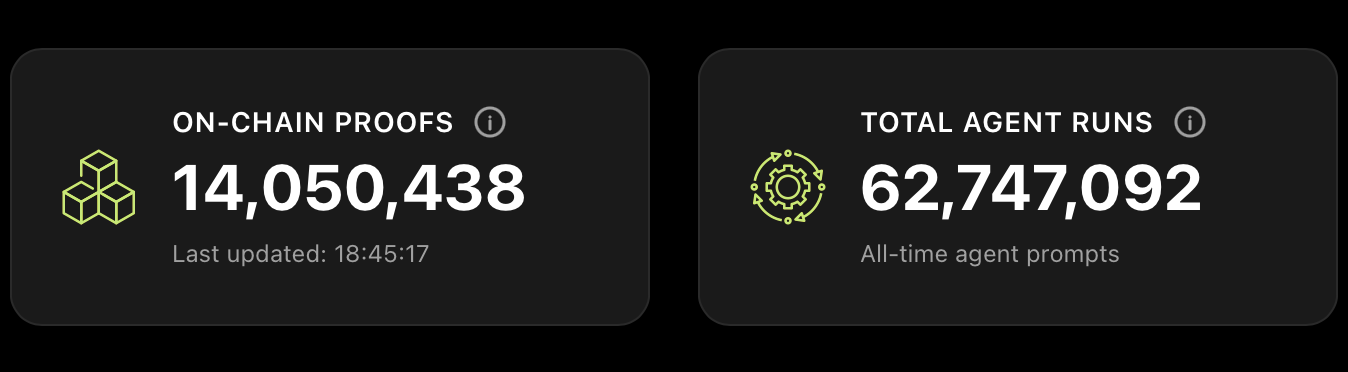 These were not simulations or internal benchmarks. They were real users, real capital, and real execution. Live across EVM chains and Solana.
The Foundation: Building Block by Block
The Beginning: Alfama Testnet
Before mainnet. Before agents at scale. Before millions of executions. There was Alfama, Warden’s first public testnet, launched in early 2024. Alfama was where theory became infrastructure.
It introduced:
Intent-based execution, where users describe outcomes and the system coordinates the required actions
Unified interaction, collapsing fragmented workflows into a single agent-driven experience
Agent-first design, built to support delegation, coordination, and execution from day one
The response was immediate.
In just six weeks:
200,000+ wallets connected
45,000+ user environments created
60,000+ cryptographic keys generated
400+ validators supporting the network
This was not hype. It was demand.
From Testnets to Mainnet
Buenavista, our second testnet, proved the agent execution model worked in practice.
Chiado, our third testnet, hardened it for production.
Together, they exposed real-world edge cases, stress-tested execution, and refined the system until it was ready for mainnet. That groundwork mattered. What followed had no margin for failure.
Warden Chain Mainnet: Making It Real
The Warden Chain mainnet launch was not a feature release. It was a transition. From experimentation to live infrastructure, from single-agent interactions to a permissionless agent economy.
With mainnet live:
The Warden Agent Network became active from genesis
Validators began securing the WardenChain, agent execution and proofs
Agents gained onchain identity, wallets, and reputation
Proofs of Prompt and execution data became publicly inspectable
Mainnet turned Warden into a platform. Developers could now publish agents built in any framework and immediately access:
Network-wide distribution through the Warden App
Native monetisation primitives
Inter-agent coordination and composability
Onchain accountability by default
This is where agents stopped being demos and became infrastructure.
The Warden team has also been an early contributor to ERC-8004, the open standard for onchain agent identity and attribution, helping shape it based on real production requirements from the Global Agent Network.
When AI Stopped Being a Demo
For years, AI agents in crypto lived in pitch decks and threads. In 2025, they started living onchain. Even with better infrastructure, crypto UX still required users to think about gas, routing, chains, and transaction construction.
Warden removed that burden.
A command like:
“Swap 100 USDC for ETH via the cheapest route”
became a single natural language instruction.
The system coordinated execution end to end, while users focused only on what they wanted done. That raised a critical question: how do you trust a system acting on your behalf with real capital?
SPEX: You Don’t Trust AI. You Verify It.
As agents began handling real money, trust became the bottleneck.
The answer was not trust. It was verification.
SPEX (Statistical Proof of Execution) became a core piece of Warden’s future infrastructure.
SPEX enables:
Verifiable AI inference
Resistance to manipulation
Cryptographic accountability for agent actions
Instead of trusting outputs, users can verify that:
An inference occurred
It followed expected statistical properties
It was executed honestly
SPEX research and development will continue, and we expect it to be a core primitive available in the near future.
Agents That Actually Did the Work
By early 2026, Warden’s agent ecosystem had moved fully into production.
What emerged was not a single flagship agent, but a coordinated network of specialized agents solving real user problems:
Uniswap Agent for fast, non-custodial swaps on Ethereum, Base, and BNB
Jupiter Agent for best-route execution on Solana
Swap and routing agents coordinating liquidity across environments
Messari Deep Research Agent delivering real-time, institutional-grade intelligence
WachAI for verification and risk-aware DeFi analysis
Portfolio and intelligent DCA agents acting continuously on behalf of users
Base-native agents optimized for Base liquidity and incentives
Community-built agents, deployed permissionlessly through the Agent Hub
This was no longer a single app. It became an ecosystem of autonomous economic actors: composable, monetizable, accountable by design. And they generated real revenue.
$802,159.76 in cumulative agent earnings.
These agents were no longer narratives. They became real businesses.
When Trading Became Social
Trading evolved too, with BetFlix and the AI Trading Terminal, where execution became:
Swipe-based strategy discovery
Competitive tournaments
Social mechanics powered by agents
Trading stopped feeling like configuration and started feeling intuitive. Agents became a new distribution layer, with strategies competing, evolving, and earning in public.
Building in the Open
One principle stayed constant throughout. Build in the open.
That meant public dashboards, open metrics, research articles, monthly updates, and onchain proofs. The system spoke for itself.
What It All Adds Up To
By early 2026, Warden had delivered:
Live mainnet infrastructure
A production-grade Agent Network powering the “Do-It-For-Me” economy
A rich AI agent marketplace
Verifiable execution through SPEX
Conversational UX that works for crypto
A revenue-generating agent economy
Millions of executions coordinated by agents
Real partnerships shipping real integrations
This is the proof of work behind the protocol. And this is not the end, because as the team put it: “If 2025 was a mistake, 2026 is going to be worse.”